
Quang Phu Cau Incense Village, Vietnam: What I Saw Inside a Traditional Craft Village
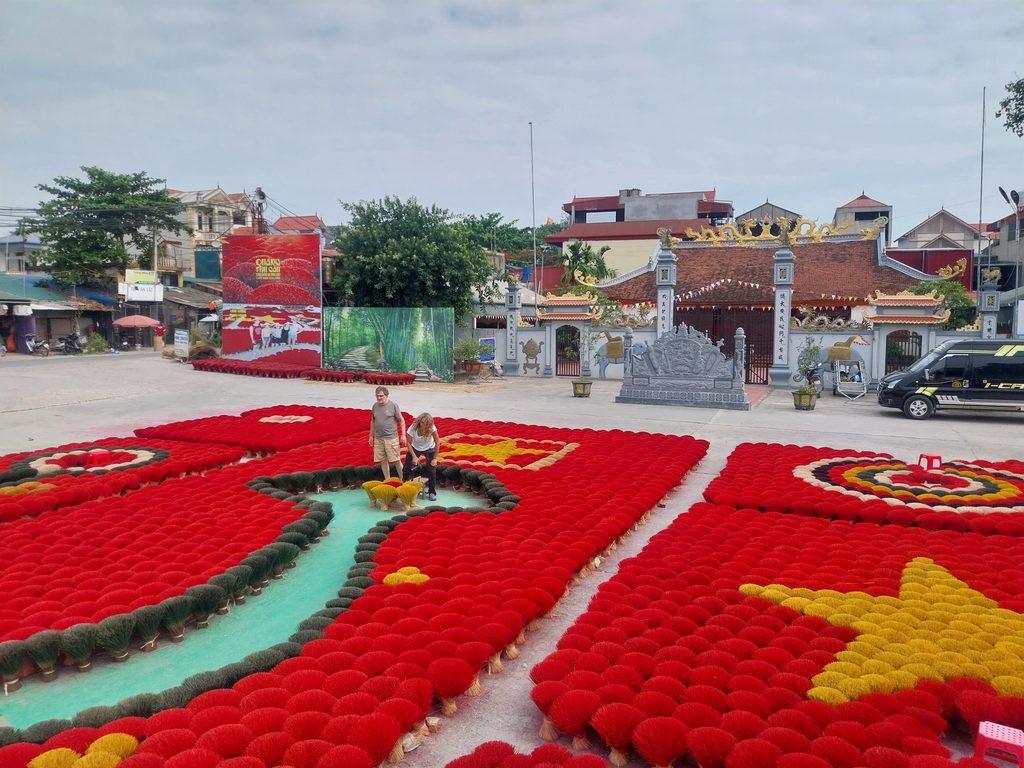
The first thing I saw when I arrived at Quang Phu Cau Incense Village was a large open yard covered with colorful incense sticks drying in the sun.
It was a striking scene. The dyed incense splints were spread across the ground, and many visitors were taking photographs.
But the colorful drying yard was only one part of what I saw that day.
I visited Quang Phu Cau on January 20, 2026, traveling alone by motorbike. I stayed for about an hour and saw several stages of incense production, from preparing and drying bamboo splints to dyeing them and making finished incense.
I also discovered something that photographs of the village rarely show: the smell of bamboo that had been soaked in water was extremely unpleasant.
For me, that combination of beautiful photographs, traditional production, unpleasant raw materials and friendly local workers made Quang Phu Cau much more interesting than simply a place to take pictures.
Quang Phu Cau Is More Than a Photo Spot
Quang Phu Cau, in Ung Hoa District of Hanoi, is a traditional craft village known for incense production. The craft has been practiced locally for more than a century.
Today, the village is also well known among international visitors because of its colorful incense-drying yards.
The bright red and pink incense splints make particularly attractive photographs, especially when large quantities are arranged across an open courtyard.
That was exactly the scene I encountered when I arrived.
There were many tourists taking photographs. Some visitors were clearly interested in the colorful display, while others seemed mainly interested in getting photographs rather than learning about how incense is actually produced.
I found that distinction interesting.
The photographs are attractive, but the craft behind them is what makes the village worth understanding.
What Happens Before the Incense Reaches the Drying Yard?
The incense splints begin as bamboo.
During my visit, I saw local people cut bamboo into shorter pieces and bundle them together. The bamboo was then soaked in water in fish ponds or small water channels before being taken out and dried.
I saw many bundles being transported for drying, including bamboo carried by ox carts.
The smell was memorable — and not in a good way.
The soaked bamboo had a very strong, unpleasant smell.
It was almost the opposite of what you might expect from a place associated with fragrant incense.
After the bamboo has been prepared, it is processed into thin bamboo splints known in Vietnamese as tăm hương. Some stages of this work can now be done with machinery, while traditional manual methods are also still used. Machinery allows producers to process much larger quantities more quickly.
I filmed both handmade and machine-assisted production during my visit.
Seeing the two methods side by side made the difference quite clear to me.
Making incense by hand is slow. Machines make the production process much faster.
The Colorful Incense Drying Yard
The most photographed part of Quang Phu Cau is probably the large drying areas.
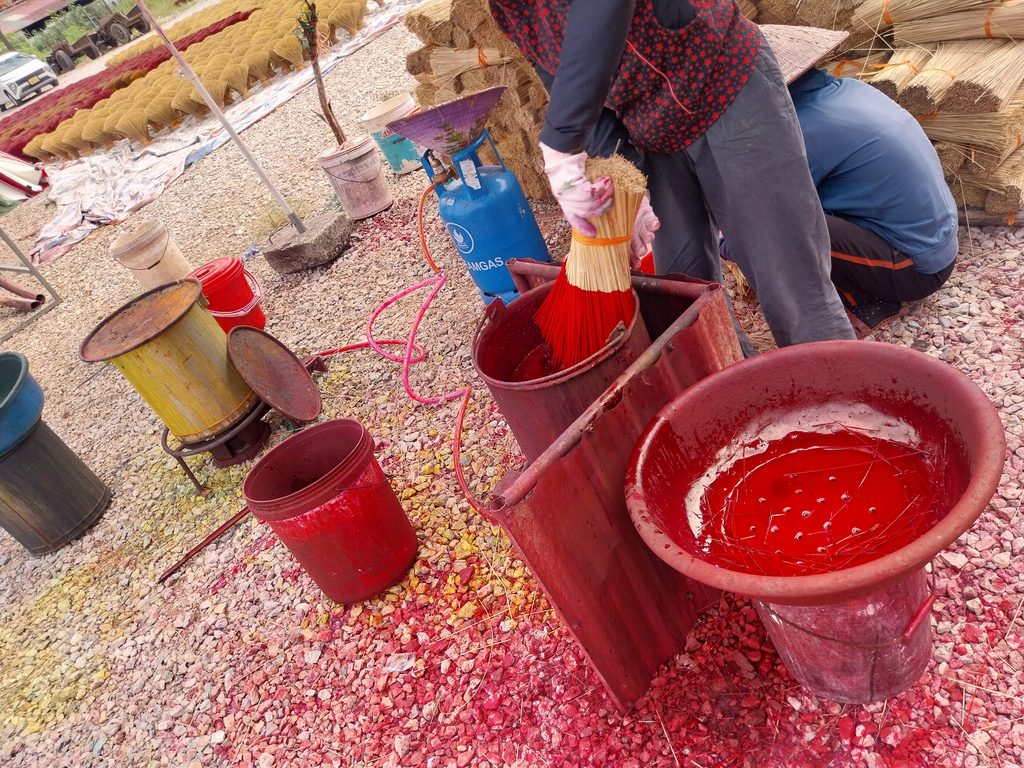
I saw workers dyeing the ends of the incense splints before spreading them out under the sun.
I spoke with a woman who was doing the dyeing at the drying yard.
I asked her whether the colored water was used to dye the ends of the incense sticks before making incense.
She said yes.
She explained that they heat a pot of colored water, dip the ends of the incense splints into it and then take them outside to dry. She also explained that another type of dyed splint is used to make incense.
She was very friendly and happy to answer my question.
This short conversation was one of the more useful moments of my visit because I was not simply looking at the colorful sticks — I was able to ask someone actually doing the work what I was seeing.
Once the dyed splints are spread across the large drying yard, they become the colorful scene that attracts photographers.
I heard tourists laughing and talking as they walked around and took photographs.
I also filmed this part of the village.
For a photographer, it is easy to understand the attraction.
For someone interested in traditional crafts, however, I think it is worth looking beyond the photograph and asking how those colorful sticks got there in the first place.
I Tried Making an Incense Stick Myself
The most memorable part of my visit was not taking photographs.
It was making an incense stick myself.
Inside a house where incense was being produced, a staff member showed me how to make one using a traditional method.
The process was surprisingly simple.
I first applied adhesive to the bamboo incense splint. Then I rolled the stick through incense powder so that the powder attached to it.
I spent about three minutes making one incense stick.
It was easy enough to do, but my finished stick was not particularly beautiful. The incense powder did not stick evenly along the bamboo.
That small imperfection was actually useful.
It made me appreciate the repetitive work involved in producing incense by hand. Doing one stick yourself is easy enough. Producing large quantities consistently is another matter.
The staff member who helped me was friendly and had a good attitude toward visitors.
I enjoyed the experience because I was no longer simply watching someone else make incense. I had actually tried one of the steps myself.
Watch My Visit to Quang Phu Cau
I filmed the parts of the visit that I found most interesting, including bamboo drying, dyeing the incense splints, handmade incense production, machine-assisted production and tourists taking photographs in the drying yard.
The video gives you a visual impression of the working environment and the colorful drying areas that are difficult to understand from photographs alone.
Why Do Vietnamese People Use Incense?
The craft becomes more meaningful when you understand what incense is used for.
Incense has an established role in Vietnamese religious and family traditions. Burning incense is commonly associated with ancestor worship and with offerings at temples, pagodas and other places of worship.
Ancestor worship is widely practiced in Vietnam, and ancestral altars traditionally have an important place in many Vietnamese homes.
This cultural context explains why incense remains an important traditional product.
When you visit Quang Phu Cau, you are therefore seeing more than a decorative object being manufactured.
You are seeing how a product used in Vietnamese cultural and religious practices is prepared.
That is also why I think it is useful to spend some time watching the actual production rather than only photographing the finished incense.
What Can Travelers Actually Experience?
A visit to Quang Phu Cau can include several different experiences depending on which production areas are operating when you arrive.
You may see:
- Bamboo being prepared and dried
- Incense splints being dyed
- Large quantities of incense drying outdoors
- Handmade incense production
- Machine-assisted production
- Finished incense products
- Tourists photographing the drying yards
- Demonstrations or opportunities to try making incense
My own visit included a chance to make one incense stick myself.
However, I would not assume that every workshop provides the same experience.
Some production areas are working households or private businesses, so visitors should ask before entering or photographing people at close range.
Look beyond the photographs
One thing I noticed during my visit was that some tourists seemed interested mainly in taking pictures.
There is nothing wrong with that — the drying yards are genuinely photogenic.
But if you have traveled all the way to Quang Phu Cau, I think it is worth spending some time watching the craft itself.
Look at the bamboo.
Watch how the splints are dyed.
Notice the difference between hand production and machinery.
Ask questions if the workers are willing to explain.
That is where the cultural experience becomes more interesting.
Practical Information for Visiting Quang Phu Cau
Location: Quang Phu Cau Commune, Ung Hoa District, Hanoi.
Distance: The village is approximately 35 km from central Hanoi.
My journey: I traveled there by motorbike.
My visit: January 20, 2026, cool weather, approximately one hour.
The village is outside central Hanoi, so navigation is useful if you are traveling independently.
The craft is particularly active around the period before Tet, when demand for incense increases.
Because production areas and visitor arrangements can vary, I recommend checking current conditions before you go rather than assuming that every workshop will be open or accessible.
Vietnam eSIM Tip for Independent Travelers
If you are exploring craft villages around Hanoi independently, mobile data can make the trip much easier.
You can use Google Maps to navigate, translation apps to communicate, ride-hailing apps to arrange transportation and your phone to check information while traveling.
This is especially useful when visiting places outside central Hanoi, where you may need to navigate between local roads and production areas.
If you want to have mobile data ready when you arrive in Vietnam, you can Vietnam eSIM before your trip
For independent travel around Vietnam, an eSIM can be a simple way to stay connected while exploring Vietnam
Is Quang Phu Cau Incense Village Worth Visiting?
For me, yes.
I only spent about an hour there, but I saw things that I could not have understood from photographs alone.
I saw the bamboo being soaked and dried. I saw the dyed incense splints spread across a large yard. I smelled the unpleasant bamboo before it became incense. I watched both traditional and machine-assisted production.
And I made an incense stick myself.
It was not a perfect one. The powder did not stick evenly, and it took me about three minutes to make it.
But that was exactly why I enjoyed the experience.
Quang Phu Cau showed me that behind the beautiful photographs of Vietnam’s incense village is a real working craft — with raw materials, repetitive manual work, machines, local workers and a product that still has a place in Vietnamese cultural and religious life.
If you are interested in seeing a traditional Vietnamese craft rather than simply visiting another major tourist attraction, I think Quang Phu Cau is well worth the trip.