
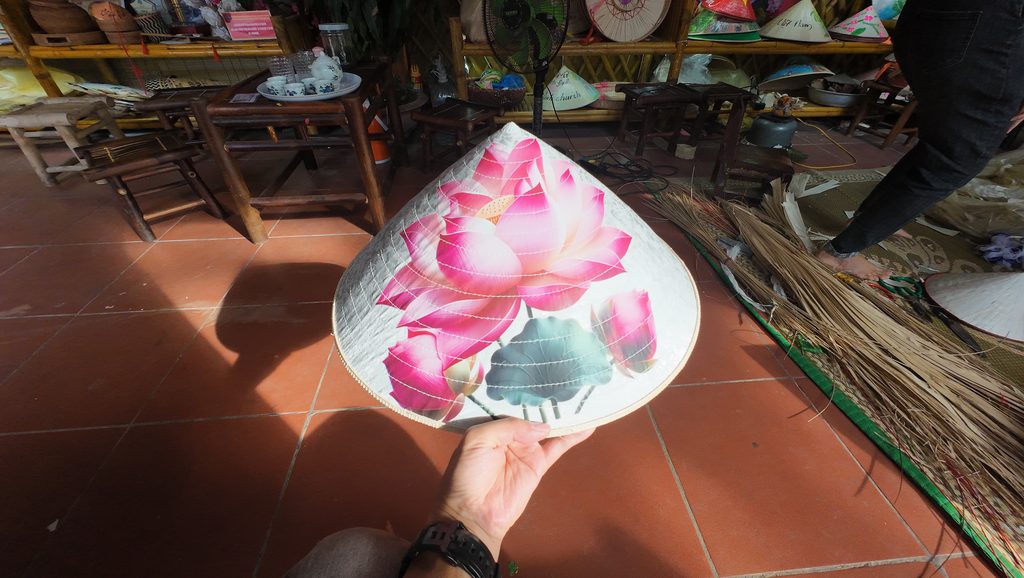
Vietnam Hat Village: A Look Inside Vietnam’s Traditional Hat Craft
I had seen Vietnam’s conical hat, or nón lá, many times before. But I had never really thought about how much work was behind one until I visited Chuong Hat Village.
On January 25, 2026, I rode my motorbike to the village by myself and spent about an hour there. The area was lively, with local shops and people moving around near the local market. Close to the village communal house, I found a place where conical hats were being made and sold.
The first thing I remember was the smell of dry leaves.
The Craft Behind Vietnam’s Famous Nón Lá
Chuong Village, also known as Làng Chuông, in Thanh Oai, Hanoi, is known for its traditional conical hats. The craft has been passed down in the community for a long time.
What interested me was discovering that making a hat is not simply one person’s job.
The people I spoke with told me that the leaves used for the hats are brought in from other regions. The leaves are collected from forested areas and transported to the village.
Different households then take responsibility for different stages of the work.
So although a finished nón lá may look like one simple handmade product, there can be several different people and families behind it.
How a Vietnamese Conical Hat Is Made
During my visit, I saw some of the process myself.
The leaves looked similar to palm leaves. Before they could be used, they needed to be prepared and flattened.
One tool particularly caught my attention. It looked to me like an upside-down rice-cooker heating element. It was being used to flatten the leaves.
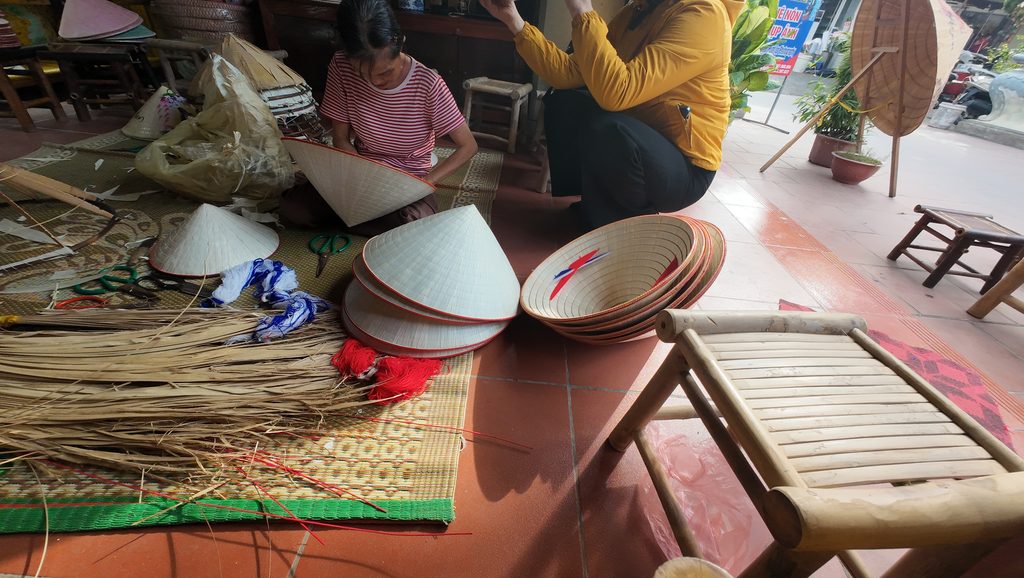
The prepared leaves were then arranged on a round mould before being sewn together.
I watched the artisan sew the hat by hand.
I did not see every stage of production during my one-hour visit, so this is not a description of the entire process. But even the stages I saw were enough to show me that a nón lá requires considerably more preparation than its simple appearance suggests.
What I Learned from the People Making the Hats
The people I spoke with told me that their craft has existed for a long time and that many well-known people have visited to see how the hats are made.
They also told me that foreign tourists come to the village to watch the production process, and some visitors are given the opportunity to try making the hats themselves.
That was interesting to hear because it shows that the village is not only producing hats for local use and sale. The traditional craft has also become something that international visitors can experience more directly.
During my visit, I also saw local people coming to buy hats as gifts. One customer asked for an additional layer of clear coating to be applied to the outside of the hat to help protect it and improve its durability.
There were also different sizes of hats available.
More Than a Souvenir
The Vietnamese conical hat is widely associated with Vietnam and has traditionally been used for practical protection from the sun and rain.
But standing in a workshop in Chuong Village gave me a different perspective.
The finished hat is only the final result. Behind it are leaves brought from elsewhere, preparation work, different households handling different stages, and artisans sewing the material together by hand.
That is the part I found most interesting.
Visiting Chuong Hat Village
For international travelers, I think Chuong Village is best understood as a living traditional craft village, rather than simply another sightseeing stop.
You may be able to see artisans working, visit places selling the finished hats and, depending on the workshop and circumstances, potentially learn more directly about the craft.
If you visit a working household, remember that it is also someone’s workplace. Ask before taking close-up photographs and avoid interrupting people while they are working.
I travelled there by motorbike, which gave me the freedom to explore the area independently.
Practical Information
Location: Chuong Village, Thanh Oai, Hanoi, Vietnam.
Distance from central Hanoi: Approximately 30 km.
Getting there: I travelled by motorbike. Private transport, taxi or ride-hailing services are other possible options.
I spent around one hour in the village. If your main interest is the craft, the amount of time you need will depend on which workshops or local producers you are able to visit.
Vietnam eSIM Tip for Exploring Craft Villages
If you are travelling independently around Hanoi, mobile data is useful for more than just checking social media.
When I travelled by motorbike to a traditional village outside the city, having mobile data can be useful for navigation, translation, ride-hailing and checking information while travelling.
If you plan to explore Vietnamese villages independently, you can get a Vietnam eSIM before your trip and have mobile data ready when you arrive.
Get a Vietnam eSIM before your trip
Final Thoughts
Before visiting Chuong Hat Village, I mostly thought of the nón lá as a familiar symbol of Vietnam.
After seeing part of the production process, I looked at it differently.
A simple conical hat can involve leaves brought from other regions, several stages of preparation, different households working on different parts, and an artisan sewing the final structure by hand.
That is what makes a visit to a Vietnamese craft village worthwhile. You are not only looking at a traditional product. You are seeing some of the people and work that keep the craft alive.