
Tran Quoc Pagoda Travel Guide: What to Know Before You Visit
Tran Quoc Pagoda is one of the best-known Buddhist sites in Hanoi. Located on a small island beside West Lake, it combines traditional Vietnamese Buddhist architecture with a peaceful lakeside setting.
For first-time visitors to Hanoi, Tran Quoc Pagoda is worth considering if you want to see a religious site without spending several hours there. A typical visit takes around 30–60 minutes, making it easy to combine with other attractions around West Lake, such as the Ho Chi Minh Mausoleum area or the Temple of Quan Thanh.
The pagoda is also an active place of worship, so visitors should treat it as a religious site rather than simply a tourist attraction.
Overview
Tran Quoc Pagoda, or Chùa Trấn Quốc in Vietnamese, is located on Thanh Nien Road between West Lake and Truc Bach Lake in Hanoi.
The site is traditionally dated to the sixth century, making it one of the oldest Buddhist temples in Hanoi. The pagoda was originally established near the Red River before being moved to its present location on Kim Ngu, or Golden Fish Island, in the early 17th century.
Today, the main attraction is not just its age. Visitors come for the combination of Buddhist architecture, religious atmosphere, gardens, and the surrounding lake.
The site is relatively compact, so you do not need a full day to explore it. If you are already visiting the West Lake area, it is a convenient stop to add to your itinerary.
Entrance fee: Free.
Typical visit time: Around 20 minutes.
Location: Thanh Nien Road, beside West Lake, Hanoi.
Opening hours can vary between sources and may change during religious events or holidays. Current travel listings commonly show morning and afternoon opening periods, so it is sensible to check before travelling if your schedule is tight.
How to Get There
Tran Quoc Pagoda is in the Tay Ho area, northwest of Hanoi’s Old Quarter.
From the Old Quarter
The easiest option for most independent travellers is a taxi or ride-hailing service. Depending on traffic, the journey usually takes around 15–25 minutes.
You can also reach the pagoda by public bus. Several bus routes serve the West Lake area, although travelling by taxi or ride-hailing service is generally more straightforward for first-time visitors.
By motorbike
If you are comfortable riding in Hanoi traffic, you can travel to the pagoda by motorbike. Thanh Nien Road is relatively easy to identify because it runs between West Lake and Truc Bach Lake.
Allow extra time for parking and walking to the entrance.
As part of a day tour
Tran Quoc Pagoda is sometimes included in Hanoi sightseeing itineraries, particularly tours covering the Ho Chi Minh Mausoleum, Presidential Palace, Temple of Quan Thanh, and West Lake.
If you are joining a day tour, check the itinerary beforehand. Some tours may only stop for a short photo opportunity rather than giving you enough time to explore the pagoda.
What to See
The Bao Thap stupa
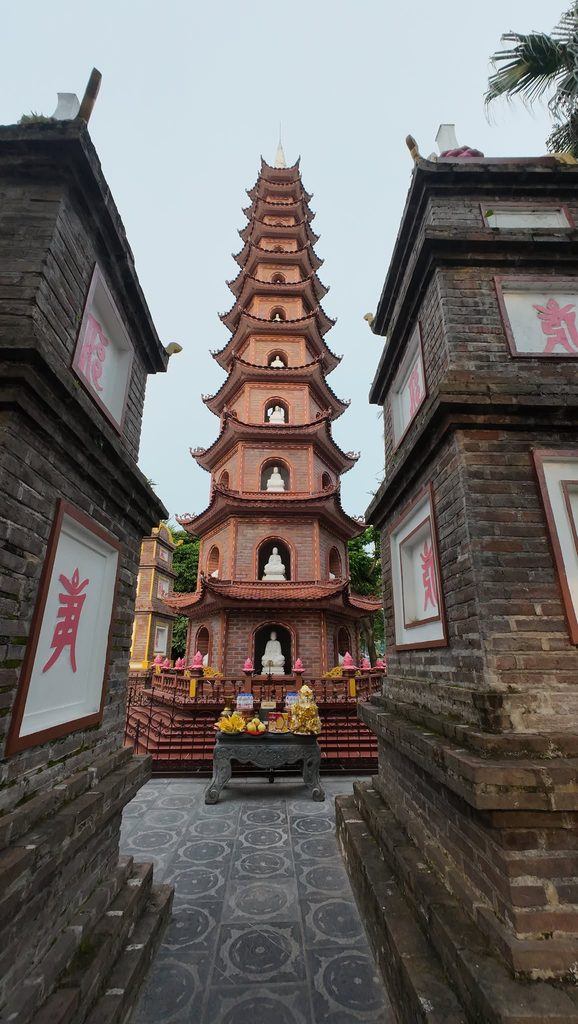
The most recognisable structure at Tran Quoc Pagoda is the red-brick Bao Thap, or Precious Stupa.
The tower was built in 1998 and has 11 floors, reaching approximately 15 metres in height. Its red colour and repeated architectural details make it one of the most photographed parts of the complex.
Take some time to walk around it rather than viewing it only from the entrance.
The main Buddhist buildings
The pagoda contains several connected worship buildings, including the front hall, incense-burning area, and upper sanctuary.
Inside, you can see Buddhist statues, altars, incense, and other religious objects.
If people are praying, keep your voice low and avoid interrupting their activities.
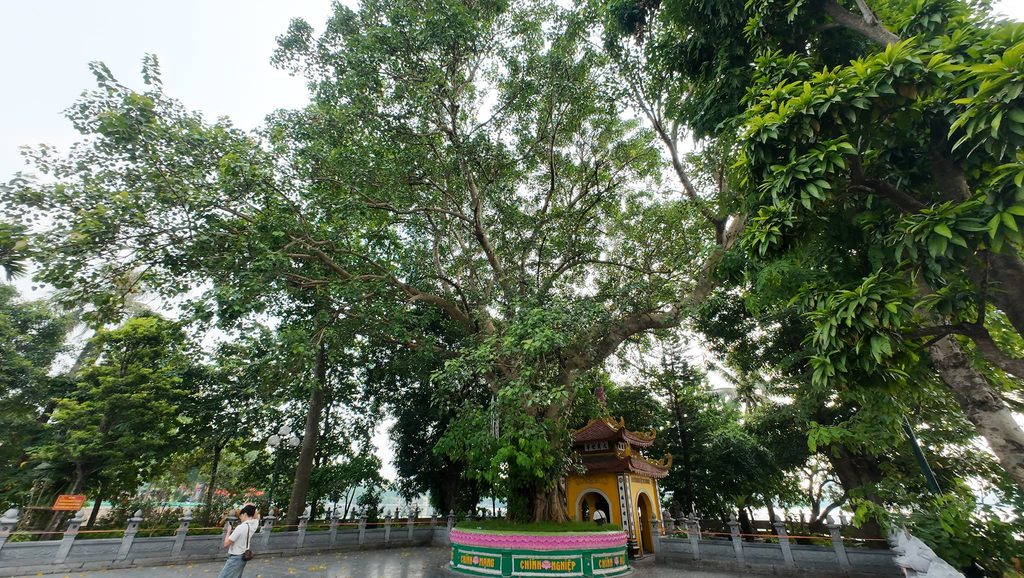
The Bodhi tree
Another notable feature is the Bodhi tree associated with the Buddhist tradition.
The tree is connected with a Bodhi tree in India and has become an important symbolic feature of the pagoda. For visitors interested in Buddhism, it provides another reason to look beyond the main stupa and explore the grounds.
The lake surroundings
One of the strongest reasons to visit Tran Quoc Pagoda is its setting.
The pagoda sits beside West Lake, and the water gives the site a noticeably different atmosphere from many temples located in busy streets.
Take a few minutes to walk along the entrance area and look back towards the lake. The combination of the pagoda, trees, water, and Thanh Nien Road is particularly attractive for photography.
Before You Visit
Dress respectfully
Tran Quoc Pagoda is an active Buddhist place of worship. Wear clothing that covers your shoulders and knees, especially if you plan to enter the worship buildings.
Avoid very short shorts, sleeveless tops, and revealing clothing. Several current visitor sources specifically recommend covering shoulders and knees.
Keep your voice down
People may be praying or making offerings while you are visiting. Speak quietly and avoid treating the worship areas like a normal tourist photo spot.
Be careful with photography
Photography is generally possible around the complex, but avoid photographing people closely while they are praying without permission.
Inside religious buildings, follow any signs or instructions regarding photography and flash.
Allow extra time for opening hours
Opening hours reported by travel sources are not completely consistent. Some list approximately 8:00 AM–4:00 PM, while others list split morning and afternoon hours.
If Tran Quoc Pagoda is an important part of your itinerary, check the current opening hours before leaving your hotel.
Bring mobile data
Having mobile data is useful in Hanoi, particularly if you are travelling independently. You may need it for navigation, ride-hailing, translation, checking opening hours, or looking up information while you are at the pagoda.
A Guide’s Personal Experience.
It looked like a large sea area. I visited Tran Quoc Pagoda with our guests. The atmosphere there was very cool because it was near West Lake. We stayed there for about 10 minutes before leaving. We saw many Indian visitors lighting incense in front of the pagoda.
Mobile Data & eSIM
If you are travelling around Hanoi independently, having reliable mobile data can make the day much easier.
You can use mobile data for:
- Google Maps and navigation
- Ride-hailing apps
- Translation
- Checking opening hours
- Looking up nearby attractions
- Contacting hotels or tour operators
- Watching or uploading travel videos
For international visitors, an eSIM can be a convenient option because you can arrange your mobile data before arriving in Vietnam without needing to visit a local phone shop immediately after landing.
If your phone supports eSIM, compare the available Vietnam eSIM plans based on data allowance, validity period, network coverage, and price before choosing one.
If you are planning to visit several destinations in Vietnam rather than only Hanoi, consider choosing a plan that remains useful throughout your trip instead of buying a separate plan for each city.
Conclusion
Tran Quoc Pagoda is a relatively easy attraction to add to a Hanoi itinerary. It does not require a full day, the entrance is free, and its location beside West Lake makes it convenient to combine with other attractions in the area.
Its main appeal is the combination of a historic Buddhist site, traditional architecture, and a peaceful lakeside setting.
For first-time visitors, it is particularly suitable if you want to experience a religious and cultural side of Hanoi without spending too much time travelling across the city.
If you are visiting independently, allow around 30–60 minutes, dress respectfully, check the opening hours before you go, and bring mobile data for navigation and other practical needs.