
I Tried Making a Vietnamese Lacquer Painting
Ha Thai Lacquer Village
The most memorable part of my visit to Ha Thai Lacquer Village was not looking at a finished lacquer painting.
It was making one.
On a cool morning on October 15, 2025, I rode a motorbike to Ha Thai with three other people. I spent about an hour in the village, including a visit to Mr. Dũng’s lacquer workshop.
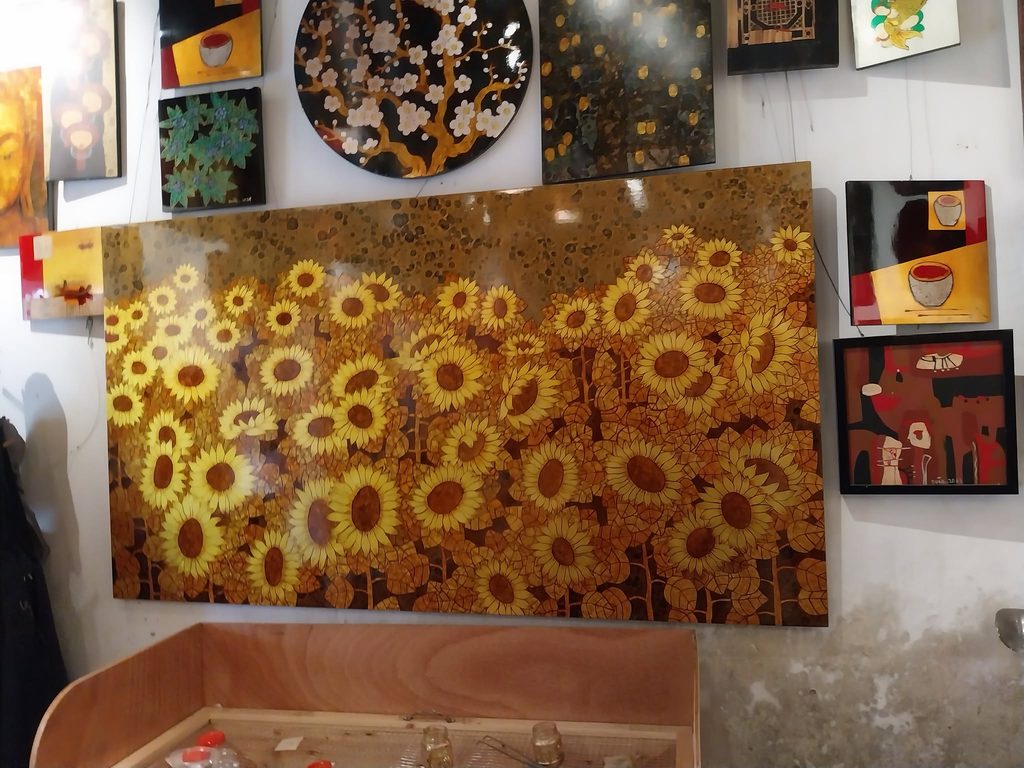
The workshop was spacious, with lacquer paintings covering the walls. There were many different designs, sizes and colours. About three people were working there, and I noticed a large amount of duck eggshell prepared for the craft.
But what made the visit different was that I was not simply watching.
Someone at the workshop showed me how to do part of the process myself.
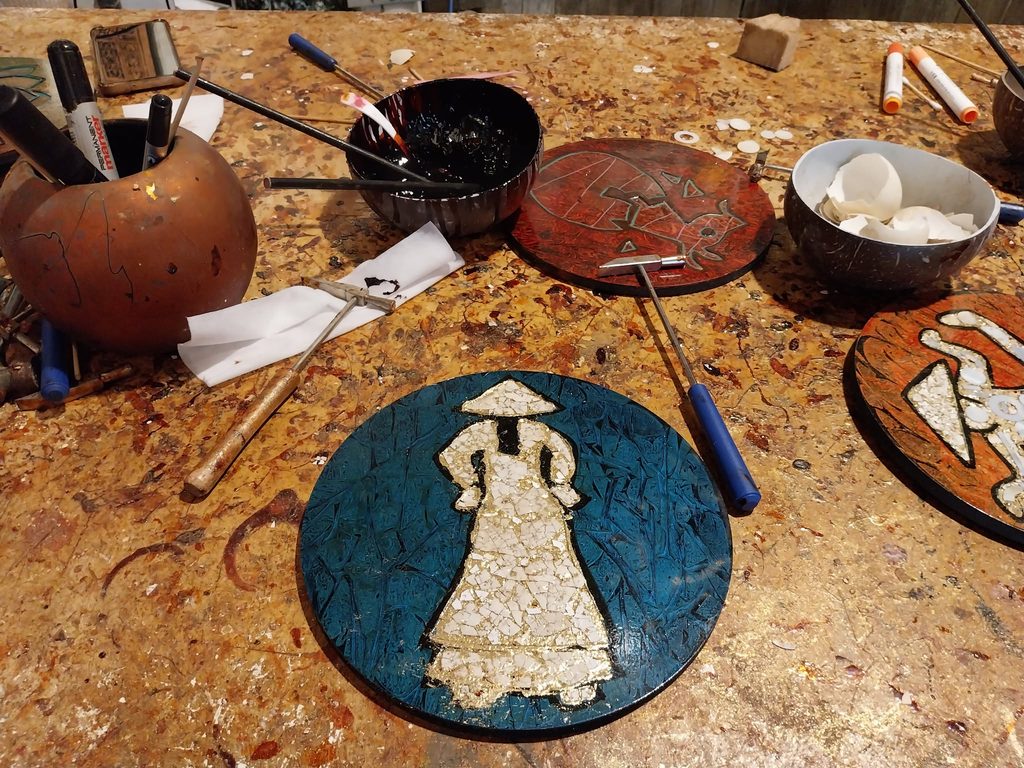
I chose a design I liked, applied glue to the surface, placed pieces of duck eggshell onto it and used a small hammer to break the shells. Then I filled the design with gold-coloured glitter and gently brushed the surface with a small hand brush.
It was a simple experience, but it completely changed the way I looked at Vietnamese lacquer art.
Watch my first-hand visit to Ha Thai Lacquer Village, including the journey to the village, Mr. Dũng’s workshop and my experience making part of a lacquer painting.
What Is Ha Thai Lacquer Village?
Ha Thai is a traditional craft village in Duyen Thai Commune, Thuong Tin District, Hanoi, known for Vietnamese lacquerware and lacquer painting.
The local lacquer tradition is generally traced back several centuries, with historical sources dating the craft in Ha Thai to around the 17th century. The village later became connected with the development of modern Vietnamese lacquer art, particularly through new techniques and materials introduced during the 20th century.
Today, lacquer remains a working craft in Ha Thai.
Local families produce a wide range of products, from lacquer paintings to decorative and household items. The products are sold in Vietnam and also exported to international markets.
That is important when visiting.
Ha Thai is not simply a place where visitors look at old handicrafts.
People are still making and selling them.
Why Are Duck Eggshells Used in Lacquer Paintings?
One of the things that immediately caught my attention at Mr. Dũng’s workshop was the amount of duck eggshell.
Eggshell is one of the materials that has become associated with Vietnamese lacquer art. Vietnamese artists in the early 20th century experimented with materials such as eggshell and mother-of-pearl, helping develop the distinctive visual language of Vietnamese lacquer painting.
At the workshop, however, I was not just reading about the technique.
I actually tried it.
First, I selected a design that I liked.
Then glue was applied to the relevant part of the picture. Pieces of duck eggshell were placed onto the surface.
The interesting part came next.
I used a small hammer to break the eggshell.
The sound of the hammer hitting the shell was one of the details I remember most clearly from the visit. Around the workshop, I could also hear running water, while the smell of glue and paint was noticeable in the air.
After the eggshell had been broken, gold-coloured glitter was used to fill the design. Finally, a small hand brush was used to gently sweep the surface.
Only after doing these steps myself did I begin to appreciate how much work can be hidden inside a finished lacquer painting.
Inside Mr. Dũng’s Lacquer Workshop
Mr. Dũng’s place was one of the most interesting parts of my visit.
The space was relatively large and the walls were covered with lacquer paintings.
There was a surprising variety.
Different designs.
Different sizes.
Different colours.
The paintings were displayed throughout the workshop, giving the place the appearance of a busy lacquer production space rather than a small souvenir shop.
Around three people were working there when I visited.
There were also many duck eggshells and small tools suitable for the production process and visitor experience.
I was shown a description of the stages involved in creating the form used for lacquer work.
This helped me understand that the decorative image is only one part of the process. Before the final artwork appears, the base itself has to be prepared and developed.
My Experience: Making Part of a Lacquer Painting
The workshop offered something I did not expect from a traditional craft village visit.
I could actually participate.
Someone guided me through the process.
I first chose a picture that I liked.
Then came the glue.
I applied the glue to the picture and placed duck eggshell onto the prepared area.
Next, I took the small hammer.
Rather than simply placing an intact piece of shell onto the picture, the shell was deliberately broken into smaller pieces with the hammer.
Then came the gold-coloured glitter.
It was used to fill the lines of the design.
Finally, I used a small hand brush to gently sweep over the surface.
The whole process was surprisingly enjoyable.
My main impression was simple: it was interesting because I could make part of the lacquer painting myself.
And there was another practical part to the experience.
If you liked the finished piece, you could pay for it and take it home.
That gives the visit a different character from simply buying a ready-made souvenir.
You have actually participated in part of making it.
What Happens Before a Lacquer Painting Is Finished?
The small activity I tried was only one part of the overall lacquer-making process.
Traditional lacquerware involves multiple stages, including preparing the base, applying layers, decorating the surface, sanding and polishing.
The exact process varies depending on the product.
Some pieces are decorated with eggshell, while other lacquer products can use materials such as mother-of-pearl, metallic materials or painted designs. The surface is repeatedly worked to achieve the smooth finish associated with lacquerware.
This is why seeing the production process is valuable.
A finished lacquer painting does not show all the preparation underneath.
At a workshop, you can begin to understand what is hidden behind the final surface.
Why Ha Thai Is More Than a Place to Buy Souvenirs
For an international traveller, it would be easy to visit a Vietnamese craft village, look around, buy something and leave.
Ha Thai can offer more than that if you take an interest in the production itself.
You can see local people working.
You can see the materials.
You can see unfinished products.
And, depending on the workshop, you may have an opportunity to participate in part of the process.
My experience at Mr. Dũng’s workshop was particularly memorable because I was able to choose a design and actually work on it myself.
That small experience gave me a better understanding of the skill behind the finished product.
What International Travelers Should Know
If you are interested in visiting Ha Thai, I would approach it primarily as a craft experience, rather than expecting a conventional tourist attraction.
A few things are worth keeping in mind.
Ask before taking photographs
The workshops are working environments.
If you want to photograph artisans, their work or specific production areas, ask permission first.
Ask whether you can try the craft
Do not assume that every workshop offers the same experience.
My opportunity to try part of the process happened at Mr. Dũng’s workshop. Other workshops may have different arrangements.
Take a closer look at the products
The variety was one of the things that surprised me.
At Mr. Dũng’s workshop, paintings covered the walls in different sizes, designs and colours.
Instead of looking at one finished painting and moving on, take time to examine the details and think about how the materials became part of the surface.
Consider buying something you helped make
If the workshop offers this option and you enjoy the experience, you may be able to pay for the piece and take it home.
For me, that would be more memorable than buying an ordinary souvenir because I had actually participated in part of its creation.
Practical Information
Location: Ha Thai Village, Duyen Thai Commune, Thuong Tin District, Hanoi, Vietnam.
Ha Thai is approximately 20 km south of central Hanoi, although the actual distance depends on your starting point and route.
I travelled there by motorbike and visited in the morning.
My visit took approximately one hour.
I found the morning visit useful for seeing people working in the workshops, but individual workshops can have their own schedules. Visitors should therefore avoid assuming that every workshop will always offer demonstrations or hands-on activities.
Vietnam eSIM Tip for Visiting Ha Thai
If you are travelling independently around Hanoi, mobile data can be very useful when visiting craft villages outside the city centre.
You may need it for:
- Google Maps and navigation;
- translation;
- finding your workshop;
- booking a ride;
- checking travel information;
- communicating with local people.
Vietnam eSIM for mobile data and navigation
Having mobile data available from the moment you arrive can make independent travel around Vietnam considerably easier.
Get a Vietnam eSIM Before Your Trip
If you are planning to explore Vietnam independently, you can check Vietnam eSIM options here:
Get a Vietnam eSIM before your trip
Final Thoughts
My visit to Ha Thai Lacquer Village was short—about an hour—but the hands-on experience made it memorable.
I could have simply looked at the finished lacquer paintings covering the walls of Mr. Dũng’s workshop.
Instead, I chose a design, applied glue, placed duck eggshell onto it, used a small hammer to break the shell, added gold-coloured glitter and brushed the surface.
That small experience helped me understand something that a finished souvenir cannot show.
Traditional craftsmanship is a process.
There are materials, tools, skills and many small decisions behind the final product.
For international travellers, that is the real attraction of Ha Thai.
You are not only seeing a traditional Vietnamese handicraft.
You can potentially see how it is made—and, in the right workshop, experience a small part of making it yourself.
That is a very different way to discover Vietnam.